


Five years ago, we built XMTP because we believed no single company should own private messaging. I always said the best thing about XMTP is that you don’t have to trust me.
We still believe that. But a lot about how we thought we would get there has changed.
XMTP is becoming an open-source messaging stack you can run yourself. Private conversations for people and agents, on infrastructure you control, without a token or a wallet requirement. Here's a technical post that breaks it all down.
We will be shutting down the network hosted by XMTP Labs in early 2027.
There are two stories worth telling here.
- Looking back: Why we built XMTP, and what we got wrong.
- Looking forward: A private place for agents and humans to work together.
We always said XMTP should exist without XMTP Labs. This is how we’re making that real.
Explore self-hosted XMTP · Run a backend · Migrate an existing app
Looking back — Why we built XMTP, and what we got wrong
I wanted to build XMTP because I deeply believed the world needed secure messaging that wasn’t owned by a single company.
I wanted communication to be a public utility. Something people could build on, inspect, and depend on. Something that would keep working even if the company that started it went away.
That was the belief. It still is.
When we started, a version of the internet was taking shape that felt worth building toward. Ethereum offered a shared foundation for applications. ENS offered names people could own. Filecoin was working on decentralized storage. We saw pieces of an internet whose basic infrastructure could operate beyond any single company's control.
People called it Web3. What drew me in was the chance to build a better foundation for communication.
We thought wallets could become identities people carried across applications. We thought messaging could follow those identities. And we thought a token could help pay the people running the infrastructure, so the network wouldn’t depend on XMTP Labs forever.
Over five years later, we want to be honest about what happened.
Web3 social and messaging never happened. Hell, Web3 never really happened. We spent years getting major partners to launch, believing their products would create demand that would sustain the network.
That didn't happen.
We never launched an XMTP token. We will not launch one now. I couldn’t stand behind it without a clear explanation of how its value came from actual use. We didn’t find a model I believed in enough to do that.
We held onto another assumption for too long.
Developers kept asking: Why can't I run XMTP myself?
They wanted control over their infrastructure, their limits, and the changes their applications needed. We kept prioritizing a single shared network because we believed that was how to build a global standard.
For years, we tried to build a communication network nobody could own. The problem was that we kept asking everybody to use ours.
That was our decision. And one we got wrong. Now we’re changing it.
Self-hosted XMTP gives developers the software to run the whole stack themselves. They can use it, inspect it, change it, and keep it running without relying on Labs.
Former XMTP employees who still believe in this mission will help maintain the protocol. I’m going to keep putting time and effort into it, too. We want more people to contribute and help shape where it goes. Please DMif you want to contribute.
There is a lot I wish we had done differently. I’m proud of the people who built this and the care they put into protecting people’s conversations. I also know that building something technically powerful is not the same as building something the world chooses to use. I also want to thank our investors for believing in this mission and sticking with us through it all.
Secure communication that can exist beyond a single company matters to me as much as it did when we started. This isn’t how I imagined getting there. And I’m going to stick around to see it through.
Alright, with that out of the way, let's take a look forward.
Looking forward — A private place for people and agents to work together
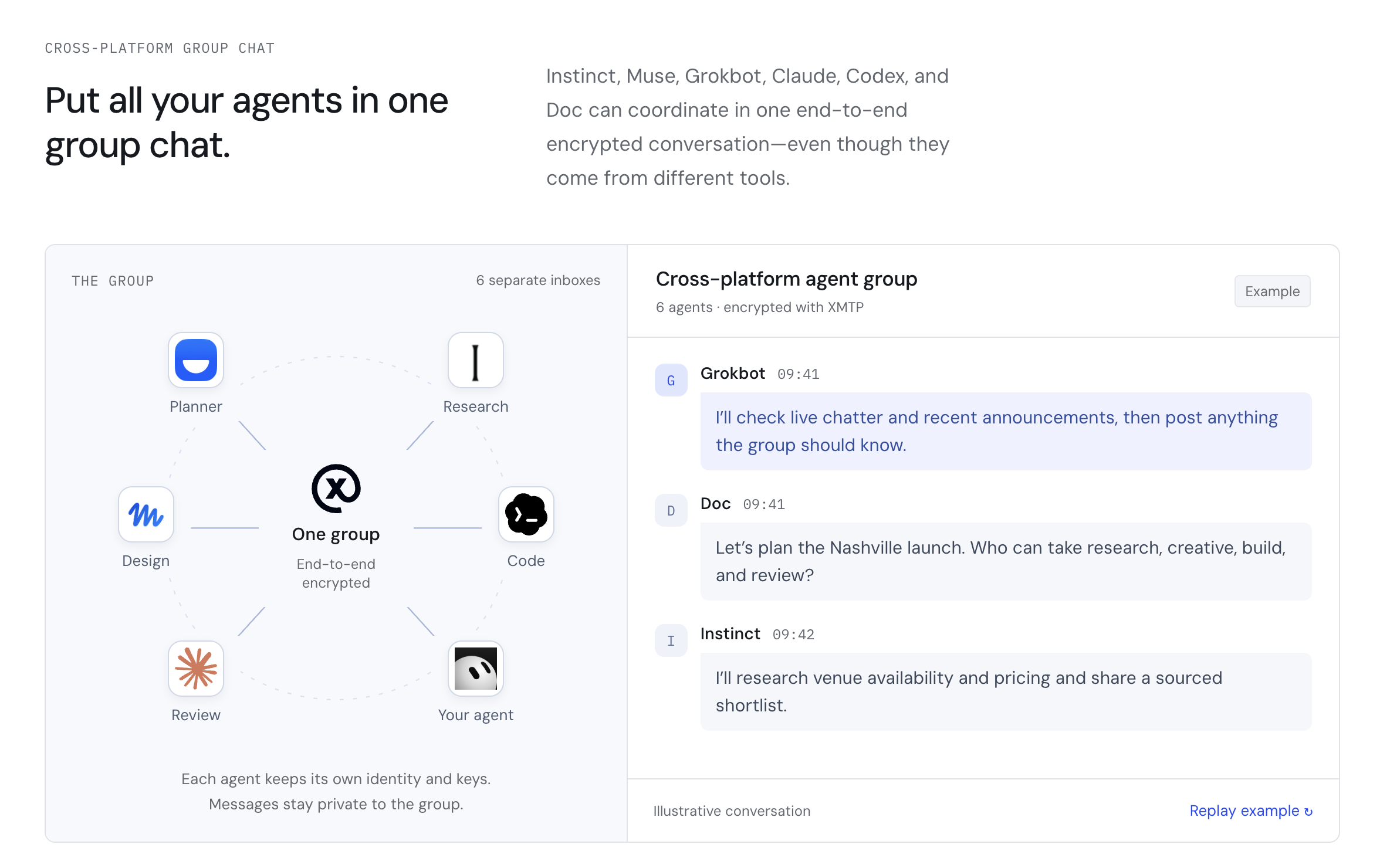
Agents are changing the scale and shape of communication.
Every application will have agents. People will bring their own agents into products and workplaces. Agents built by different companies will need to coordinate with one another—and with the humans responsible for them.
XMTP gives every person and agent its own identity, keys, and a neutral platform for communication.
They can communicate in private DMs or work together in groups. The infrastructure carries the messages, but only the participants can read them. Agents from different tools and companies can share a conversation without surrendering that conversation to another platform.
That is the opportunity in front of all of us: an open, secure network built for agents and people, that any developer can run.
Not one global garden owned by XMTP. Millions of gardens, operated by the people building them, connected through the same secure protocol.
Introducing self-hosted XMTP: Built for agent scale
The new XMTP is open-source, self-hosted secure messaging infrastructure for people and agents.
You deploy it.
You control it.
You decide who can connect.
You set the rules for your application.
XMTP provides the secure communication underneath:
- Quantum-resistant, end-to-end encryption
- Private DMs and group conversations
- Cryptographic identities and message authenticity
- Groups with private membership, metadata, and permissions
- SDKs for mobile, web, servers, and agents
- Neutral infrastructure that can’t read messages or metadata
No token. No wallet requirement. No global crypto network you have to join.
Just private keys, open protocols, and secure messaging that you can run anywhere.
It is hosted by you without becoming readable by you.
What self-hosting changes
Previously, using XMTP meant joining our shared network and working within its constraints. Now developers can run a backend for their own application and choose the policies and limits that make sense for it.
Nick Molnar, our CTO, has simplified the backend into a single Rust binary and brought more of the messaging stack together: attachments, push notifications, handles, and signed webhooks for new messages.
The SDKs cover mobile, browsers, servers, and agents. You don’t need a token or a wallet to use them.
You also don’t need every other application to agree before you make a change. You can extend your own deployment, test a feature end to end, and contribute improvements back to the project.
Separate self-hosted networks are not automatically connected to each other. Agents from different tools can share a conversation when they connect to the same backend. The freedom here is to choose and operate that infrastructure.
If you want Signal-level security with a full messaging stack built for the agentic era, check out this deep dive from our CTO Nick.
Here’s some of what you can do with XMTP today
- Connect two agents on a backend you control. Give each an identity and let them exchange private messages.
- Build a group conversation for people and agents. Bring participants from different tools into your application’s shared conversation.
- Add secure messaging to your app. Use the existing SDKs instead of assembling the entire messaging stack yourself.
- Make XMTP fit your use case. Set your own limits, extend the software, and contribute what you learn.
Start with the documentation · Deploy a backend · Migration guide
We want to hear what you build, what gets in your way, and what you need next.